Detective Fiction Plot Generator
Generate detective story premises with a puzzle at the center, a sleuth with a method all their own, and a closed circle of suspects who each have something to hide.
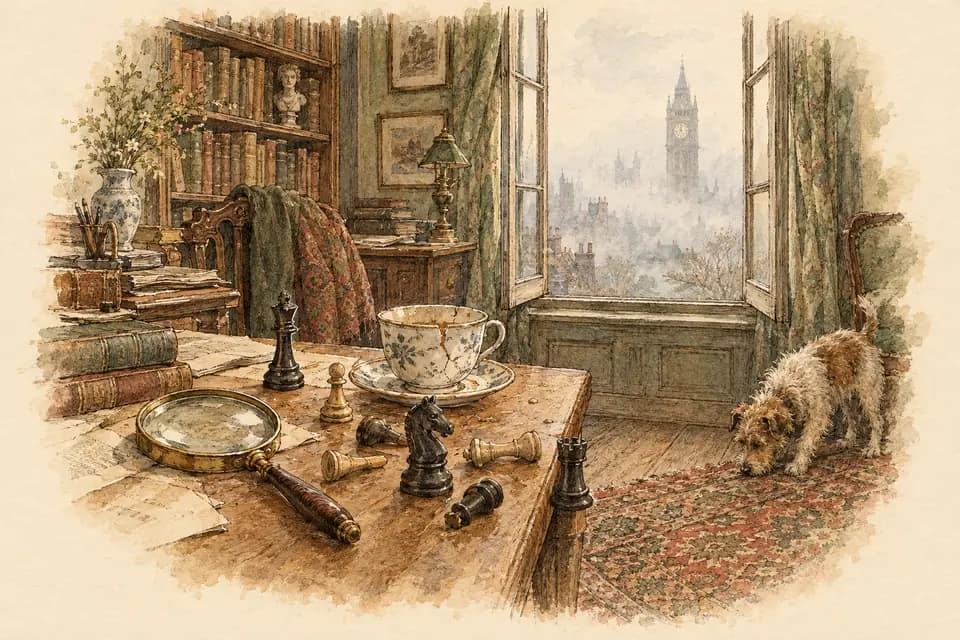
- Sample
The Barra Wedding
Retired schoolteacher Agnes Morrow takes the ferry to the Isle of Barra for a former pupil's wedding. The morning after the ceilidh, the groom's father is found dead at the foot of the harbor wall, and the island's only police officer is the bride's cousin. Agnes taught half the guests. She knows which of them lie well, and which one always wanted her approval.
- Sample
Collection Plate
Leon Achebe, an Atlanta private investigator who mostly catches cheating spouses, is hired by a church deacon to find out who is skimming the Sunday collection. The thief is easy to find: the pastor's son. The hard part starts when the son turns up dead two days later, and the deacon who hired Leon has an alibi only Leon is in a position to break.
- Sample
Silt
In 1897, Dr. Anand Ghosh, a police surgeon in Calcutta, is asked to sign the death certificate of a British tea merchant who drowned in his own bathtub. The man was drunk, the door was bolted, and the Commissioner wants it closed by morning. Ghosh finds river silt in the dead man's lungs. Saying so out loud will cost him his post.
- Sample
The Medallion Murders
A unique medallion is found at a series of grisly murder scenes. Detective Evan Hart, socially flawed but brilliant, must unlock the medallion's secrets before the next victim falls.
- Sample
Gone with Power
When the most powerful figures in the city start vanishing, private investigator Laura King is hired to find them. Balancing personal demons and deadly conspiracies, she uncovers a shocking truth.
- Sample
Cold Whisper
Ash, a retired detective haunted by an unsolved cold case, receives anonymous clues that resurrect his old investigation, leading him into a dangerous labyrinth of deceit, vengeance, and redemption.
- Sample
Seeing Death
In a community of psychics, a murder occurs. Suspicion ensues. Psychic detective Aurelia uses her unique abilities to solve the murder. Is she hunting a killer, or is the killer hunting her?
- Sample
Paradigm of the Past
Detective Sam Carter, known for solving 'impossible cases', finds himself tormented by a serial killer mimicking crimes from unsolved cases. Carter must face these open wounds in a race against death itself.
Detective Fiction: what makes the plot work
Detective Fiction places the spotlight on detectives, investigators, and sleuths as they solve intricate puzzles and uncover hidden truths.
Play fair with every clue
Every fact the detective uses in the final explanation should have appeared on the page earlier, even if it was disguised or buried in a list. Readers of detective fiction will flip back to check. If they find the key clue was kept from them, they won't trust your next book.
Give your detective a narrator
A sidekick narrator lets readers see the evidence without seeing the detective's reasoning. Dr. Watson does this for Sherlock Holmes, and Captain Hastings does it for Poirot in Agatha Christie's The Mysterious Affair at Styles. The best sidekicks are sharp enough to trust and slow enough to be surprised.
Close the circle
Agatha Christie's And Then There Were None strands ten people on an island off the Devon coast, and the killer has to be one of them. A closed setting (a country house, a ship, a snowed-in lodge) limits the suspects and makes every conversation tense. Make sure each character had the means and the chance to be guilty.
Pick a tradition and keep its promises
Golden Age puzzles and hard-boiled private eye novels are both detective fiction, but they promise different things. Dashiell Hammett's The Maltese Falcon gives Sam Spade a city full of liars and a personal code, not a drawing room and a tidy reveal. Choose your tradition, and the right tone, violence and ending follow.
More Mystery & Crime plot generators
Or see the whole shelf: Mystery & Crime plot ideas.
 Crime FictionGenerate crime fiction premises that look at a crime from every side: who did it, who paid for it, who covered it up, and what the neighborhood still remembers.
 Multicultural FictionGenerate mystery premises where the culture is part of the case: a detective who reads a community from the inside, and clues that only make sense if you know…
 Police StoriesGenerate police story premises that follow a case through the station as much as the streets: partners, paperwork, politics, and the officer who can't let one file go.
 Women DetectivesGenerate mysteries led by women investigators, from village sleuths and private eyes to detective inspectors, each with a method shaped by who she is and what…
Names, a first scene and a title
Questions about Detective Fiction plots
What's the difference between a detective novel and a police procedural?
A detective novel centers one investigator and their reasoning, whether a private eye, an amateur or a police officer. A police procedural focuses on how a police team actually works a case: forensics, interviews, warrants, politics. The puzzle matters most in the first, the process in the second.
Should my detective be an amateur or a professional?
Professionals have access to crime scenes, records and suspects, but come with procedure you have to get right. Amateurs need a believable reason to investigate and a way to get information, which often comes from their job as a journalist, doctor or librarian. Amateur sleuths are common in cozy mysteries, professionals in darker books.
How should the reveal scene work?
The classic reveal gathers the suspects while the detective walks through the evidence. Whatever form you choose, keep the explanation brisk, point to clues the reader actually saw, and end on the human truth behind the crime rather than the mechanics. Leave a short chapter afterward for consequences, so the book doesn't stop on a lecture.
Found the plot? Write it.
Take it into Chapterly: outline it on a board, name the cast, and write chapter one tonight.
Plans from $9.99 a month. Cancel any time. Your words are always yours.