Historical Fiction Title Generator
Historical novels carry their period in the title: a trade, a house, a war, a city. Tell the generator your era and setting and get titles that would sit comfortably beside Kristin Hannah and Hilary Mantel.
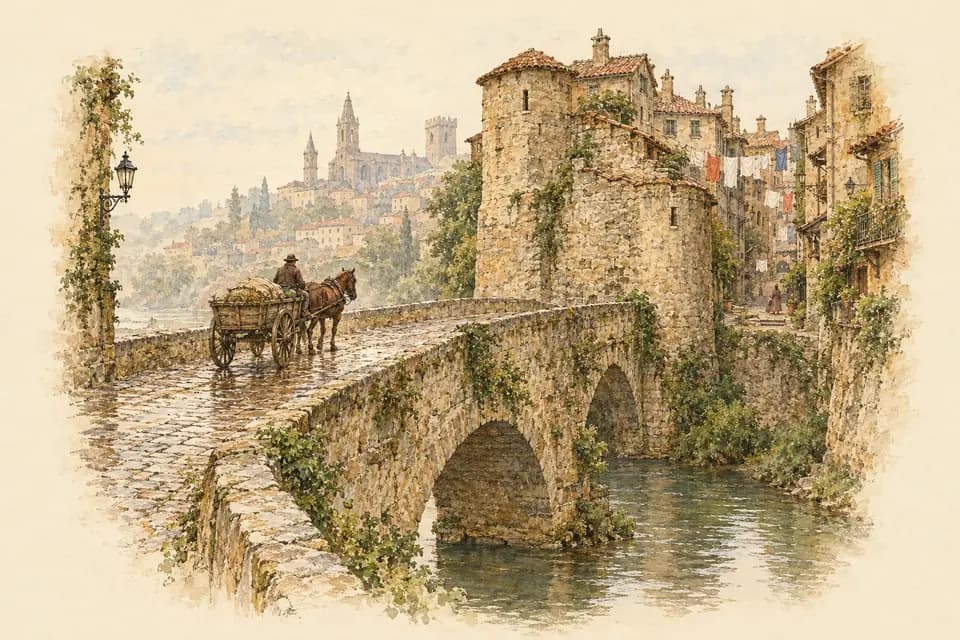
- Sample
The Lamplighter's Ledger
A Victorian lamplighter records what he sees on midnight rounds.
- Sample
Ration Book Brides
Three Liverpool war brides trade coupons and secrets in 1944.
- Sample
Salt Road
A Saharan caravan in 1350 and the scribe keeping its accounts.
- Sample
What the Telegraph Operator Knew
A small-town telegraph operator reads every 1918 death notice first.
- Sample
Hester Vane, Bluestocking
A Regency astronomer publishes her discoveries under her brother's name.
- Sample
The Almshouse at Tanner's Ford
A 1692 poorhouse keeper shelters a woman accused of witchcraft.
- Sample
Ask the Ferryman
A Mississippi ferryman in 1858 carries fugitives across at night.
- Sample
Bring Me the Blue Silk
A Versailles seamstress overhears too much during a royal fitting.
- Sample
Who Burned the Mill at Lowell?
Mill girls, an 1836 strike, and the fire that followed.
- Sample
Winter Wheat, 1933
A Dust Bowl family stays put while their neighbors head west.
- Sample
The Weight of Gold Leaf
A Florentine apprentice gilds altarpieces as the plague reaches Florence.
- Sample
Wireless
A young woman intercepts German Morse at a 1941 listening station.
Naming Historical Fiction books: what works
Historical Fiction blends the intrigue of history with storytelling. This genre revives past events and characters, offering glimpses into different eras and cultures. It connects readers to yesteryear, through tales of love, war, triumph, and tragedy.
The title of your historical book or story is a window into the past. Choose a name reflecting the era, location, or events depicted. Use evocative, period-appropriate words to transport readers through time.
Name the trade
A job title gives readers the era and the point of view in two words. The Lost Apothecary by Sarah Penner and The Personal Librarian by Marie Benedict and Victoria Christopher Murray each promise a woman with a particular skill at a particular moment in history. Ask what your protagonist does all day, then consider naming the book after it.
Let a place do the dating
Wolf Hall is named for the Seymour family's house, and Cold Mountain by Charles Frazier for the North Carolina peak Inman walks toward. A real place name sounds old without a single archaic word. It also helps readers who search for books set in that region.
Use one period word, not five
A single word with period flavor, like 'wireless', 'almshouse' or 'bluestocking', sets the clock. Stack several and the title tips into costume drama. Pair the period word with plain modern English so readers can say it without stumbling.
Handle the possessive formula with care
The Paris Wife by Paula McLain and The Aviator's Wife by Melanie Benjamin earned their titles, and a long run of books followed with a wife, daughter or sister attached to a job. The pattern still signals the genre, but it is now hard to remember one from another. If you use it, make the first noun strange enough to stick.
Well-known Historical Fiction titles
Titles that already work in this genre. Read them for shape and length: how many words, how much they give away, what they leave out.
| Title | Author | Published |
|---|---|---|
| The Pillars of the Earth | Ken Follett | 1989 |
| Wolf Hall | Hilary Mantel | 2009 |
| The Other Boleyn Girl | Philippa Gregory | 2001 |
| All the Light We Cannot See | Anthony Doerr | 2014 |
| The Book Thief | Markus Zusak | 2005 |
| Outlander | Diana Gabaldon | 1991 |
| War and Peace | Leo Tolstoy | 1869 |
| Les Misérables | Victor Hugo | 1862 |
| A Tale of Two Cities | Charles Dickens | 1859 |
| I, Claudius | Robert Graves | 1934 |
| Gone with the Wind | Margaret Mitchell | 1936 |
| The Name of the Rose | Umberto Eco | 1980 |
| The Nightingale | Kristin Hannah | 2015 |
| The Help | Kathryn Stockett | 2009 |
| Girl with a Pearl Earring | Tracy Chevalier | 1999 |
| The Scarlet Letter | Nathaniel Hawthorne | 1850 |
| The Shadow of the Wind | Carlos Ruiz Zafón | 2001 |
| The Alienist | Caleb Carr | 1994 |
| The Last Kingdom | Bernard Cornwell | 2004 |
| The Tudor Secret | C.W. Gortner | 2011 |
 Thrillers & SuspenseA thriller title has one job: make a stranger in an airport pick up the book.
 RomanceRomance readers decide in a second whether a book is their kind of love story.
 Mystery & CrimeMystery readers like a title that turns out to be a clue.
 Science Fiction and FantasyFantasy titles promise a world; science fiction titles promise an idea.
 Movie, TV, and Literary Fan FictionFic titles follow their own rules: lyric fragments, quotes, puns and lowercase sentences.
 Contemporary FictionContemporary fiction lives on the book club table, where titles are quieter and do more work.
A plot, a first scene, a shelf
Questions about Historical Fiction titles
Should the title name the war or the year?
Dates and war names can help search, but they can also make a novel sound like a textbook. Most bestsellers suggest the period through a place, a job or an object and let the cover and blurb confirm it. For less familiar settings, a place name usually does more work than a year.
Can I use a real historical figure's name in the title?
Many novels do. Maggie O'Farrell's Hamnet is named for Shakespeare's son, while Hilary Mantel kept Thomas Cromwell at the center of three novels without ever naming him in a title. Use the real name when the book stays close to that person; if they are a side character, build the title around your own protagonist.
How is a historical fiction title different from a historical romance title?
Historical romance titles tend to name the couple's setup: a duke, a wager, a scandal, a marriage of convenience. Historical fiction titles point to setting and stakes instead. A title with 'Duke' in it will be read as romance, so leave it out unless the love story is the main plot.
A title deserves a book.
Put it on a cover, write the first chapter under it, and see if it holds.
Plans from $9.99 a month. Cancel any time. Your words are always yours.