Role Playing & Fantasy Games Title Generator
Titles for core rulebooks, setting sourcebooks, adventure modules, game master advice and histories of the hobby. Suggestions follow the shelf's habits, from the in-world author's guide to the strange one-word zine.
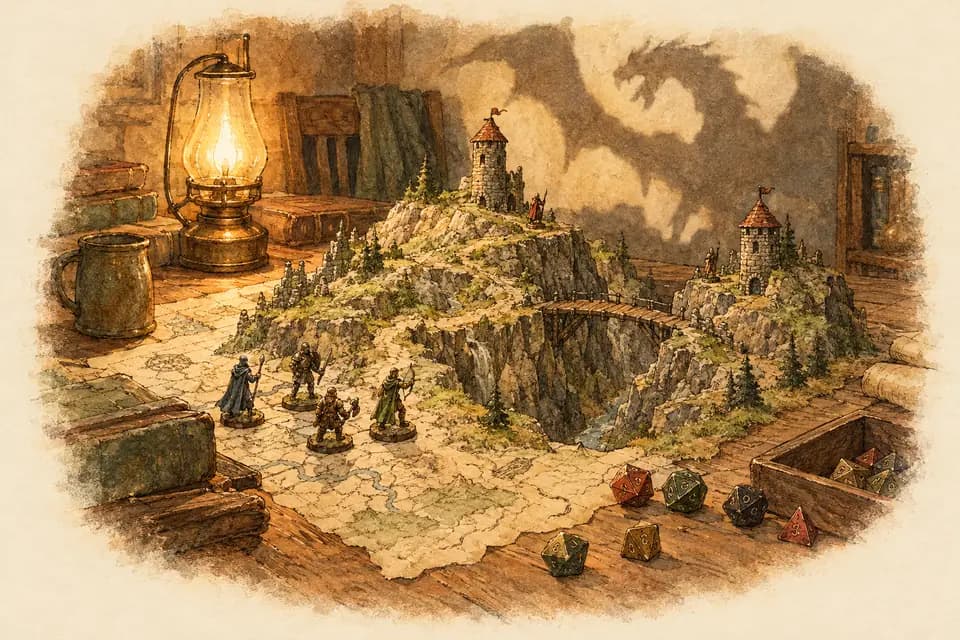
- Sample
The Salt Warrens
A fifth-edition dungeon crawl under an abandoned salt mine
- Sample
Gearwright's Compendium of Siege Engines
An in-world engineer's guide to war machines for fantasy campaigns
- Sample
Session Zero: Building a Table That Lasts
GM advice on expectations, safety tools and scheduling
- Sample
Thieves of the Lantern Coast
A port-city setting sourcebook for heist-focused campaigns
- Sample
Roll for Initiative, Mom
A memoir of running a weekly game for three teenagers
- Sample
Hexcrawl: Designing Sandbox Wilderness Campaigns
Map, travel and encounter tools for open-world tabletop play
- Sample
Bestiary of the Drowned Fen
Swamp monsters, lair maps and encounter tables for any system
- Sample
Basement Dragons: Tabletop Games in the Suburbs, 1974 to 1990
A social history of early players and the 1980s moral panic
- Sample
What Does the Ogre Want?
A GM's guide to monster motives and nonlethal encounters
- Sample
Ashfall Core Rules
Core rulebook for a survival RPG after a supervolcano
- Sample
Twelve Taverns
Drop-in tavern locations with menus, regulars and rumor tables
- Sample
The Lich's Ledger
A villain sourcebook told through an undead accountant's records
Naming Role Playing & Fantasy Games books: what works
This genre celebrates the creativity and storytelling of role-playing games and fantasy worlds. It encompasses guides, lore, and narratives that enhance the gaming experience.
Titles should capture the essence of fantasy and adventure, reflecting the themes and spirit of role-playing games and their rich, imaginative settings.
Lead adventures with a place or a threat
Players remember a location they can walk into or a villain they can fight. Tomb of Horrors, Curse of Strahd and Call of Cthulhu's Masks of Nyarlathotep each promise a destination or an enemy in a few words. Save the level range and system for the cover banner or subtitle.
Credit an in-world author
Fifth edition Dungeons & Dragons made a habit of naming supplements after characters in the setting: Volo's Guide to Monsters, Xanathar's Guide to Everything. A fictional expert gives the book a voice and a running joke. It works best when that voice actually appears in the text.
For GM advice, name the job
Game masters want help with a specific task: prep, pacing, improvisation, safety. Michael Shea's The Lazy Dungeon Master promises less prep in four words, and the title became shorthand for his method. Graham Walmsley's Play Unsafe names an attitude instead, which suits a short book about improv.
Histories can borrow the hobby's jargon
Books about the hobby can wink at the people who play. David M. Ewalt's Of Dice and Men puns on Steinbeck while saying exactly what it covers, and Jon Peterson's Playing at the World sounds like a game and a history at once. Pair the joke with a plain subtitle naming the era or the company.
Well-known Role Playing & Fantasy Games titles
Titles that already work in this genre. Read them for shape and length: how many words, how much they give away, what they leave out.
| Title | Author | Published |
|---|---|---|
| Dungeons & Dragons Player's Handbook | Wizards RPG Team | 2014 |
| Pathfinder Core Rulebook | Paizo Publishing | 2009 |
| Call of Cthulhu: Horror Roleplaying | Sandy Petersen | 1981 |
| Warhammer Fantasy Roleplay | Games Workshop | 1986 |
| Shadowrun Core Rulebook | Catalyst Game Labs | 2013 |
| Vampire: The Masquerade | White Wolf Publishing | 1991 |
| GURPS Basic Set: Characters | Steve Jackson | 1986 |
| Fate Core System | Evil Hat Productions | 2013 |
| Starfinder Roleplaying Game: Core Rulebook | Paizo Publishing | 2017 |
| Cyberpunk 2020 | Mike Pondsmith | 1990 |
| The Dark Eye Core Rules | Ulisses Spiele | 2016 |
| Mutants & Masterminds Hero's Handbook | Green Ronin Publishing | 2002 |
| Savage Worlds Deluxe: Explorer's Edition | Pinnacle Entertainment | 2012 |
| Mouse Guard Roleplaying Game | Luke Crane, David Petersen | 2008 |
| Tales from the Loop RPG: Rulebook | Free League Publishing | 2017 |
| Numenera Corebook | Monte Cook | 2013 |
| The Strange Corebook | Monte Cook, Bruce R. Cordell | 2014 |
| Ironsworn | Shawn Tomkin | 2018 |
| Monster of the Week | Evil Hat Productions | 2012 |
| Symbaroum Core Rulebook | Free League Publishing | 2014 |
 Art, Architecture, & PhotographyPhotobooks, architecture monographs, criticism and how-to-draw manuals all share this shelf, and each one names itself differently.
 Astrology, Divination & TarotName your tarot guide, birth-chart workbook or rune handbook.
 Biographies & MemoirsFind a title for your memoir, or for the biography you've spent years researching, that sounds like a life and not a resume.
 Business & InvestingBusiness books live or die on a short title and a subtitle that states the promise.
 Cooking, Food & WineA cookbook title has to tell a hungry browser what's for dinner and whose kitchen they're in.
 Crafts & HobbiesKnitters, quilters, potters and whittlers all scan the shelf for their own craft first.
 Current Affairs & PoliticsPolitical books argue, report or confess, and the title has to say which.
 Diet, Health, & FitnessName your training plan, healthy cookbook or movement guide with a title that says what the reader will actually do.
 Education & ReferenceTextbooks, handbooks, dictionaries and teaching guides need titles that tell a student or teacher exactly what's inside.
 EngineeringEngineering books range from bridge histories to circuit design manuals, and their titles split the same way.
 HistoryHistory titles usually make a promise twice: once in a short title that sets a scene, and again in a subtitle that names the period and the stakes.
 Home & GardenGardeners shop for their conditions and decorators shop for a feeling.
 HumorA funny book's title is its first joke, and readers judge the whole book by it.
 Music, Film, & Performing ArtsRock memoirs, film criticism, acting manuals and theater histories each borrow from the art they cover.
 NatureNature books are usually about one bird, one shore, one forest, watched closely.
 New Age & Alternative BeliefsTitles for books on energy work, manifestation, crystals, channeling and the inner life.
 Parenting & FamilyParents shop for these books at 2 a.m.
 PetsTitles for dog training manuals, cat behavior guides, rabbit and reptile care, and the memoir about the dog who changed everything.
 PhilosophyTitles for books that ask how to live, what we owe each other, and whether we can know anything at all.
 Politics & Political ScienceTitles for books on elections, institutions, policy fights and the ideas behind them.
 ReligionTitles for devotionals, Bible studies, theology, faith memoirs and books on Jewish, Muslim, Buddhist and Hindu practice.
 ScienceTitles for popular science on genes, galaxies, microbes, the brain and the people who study them.
 Computers & TechnologyTitles for programming guides, engineering handbooks, security books and histories of the industry.
 Self-Help & RelationshipsTitles for books on habits, confidence, boundaries, dating, marriage and recovering from hard years.
 Social SciencesTitles for books on why people behave, gather, trade and believe as they do.
 SportsTitles for athlete memoirs, season-long team stories, coaching manuals and histories of the game.
 Study Aids & Test PrepTitles for exam prep books, study guides, flashcard sets and revision workbooks.
 True CrimeTitles for books on murders, frauds, cold cases and the investigators who wouldn't let go.
 TravelTitles for travel memoirs, walking books, road trips, food travel and practical guidebooks.
 WeddingsTitles for wedding planners, budget guides, etiquette books, toast and vow helpers, and memoirs of a big day gone sideways.
 Women's StudiesTitles for feminist essays, women's history, gender research and memoirs about women's work, bodies and power.
A plot, a first scene, a shelf
Questions about Role Playing & Fantasy Games titles
Can I put 'Dungeons & Dragons' in my sourcebook title?
Dungeons & Dragons is a Wizards of the Coast trademark. The rules in the System Reference Document 5.1 are released under a Creative Commons license, but that license doesn't cover the brand name, so independent publishers usually write compatible with fifth edition or 5E instead. Products sold through the DMs Guild program follow that program's own branding rules.
How long should an adventure module title be?
Short. Many classic adventures use two to four words, often a place or a monster. The system, level range and party size go in a subtitle or a cover banner, such as a 5E adventure for four characters of levels 3 to 5.
What makes a good title for an indie zine or one-page dungeon?
Indie and old-school scenes favor short, odd, physical words that look good in big type: a body part, a substance, a ruin. The title should hint at the mood more than the plot. Put the system or compatibility note small, on the back or the first page.
A title deserves a book.
Put it on a cover, write the first chapter under it, and see if it holds.
Plans from $9.99 a month. Cancel any time. Your words are always yours.