Norse Name Generator
Get a Viking name with its Old Norse meaning, then add a patronymic or a byname. Bjorn Eiriksson or Bjorn Ironside: both were ways to tell one Bjorn from another.
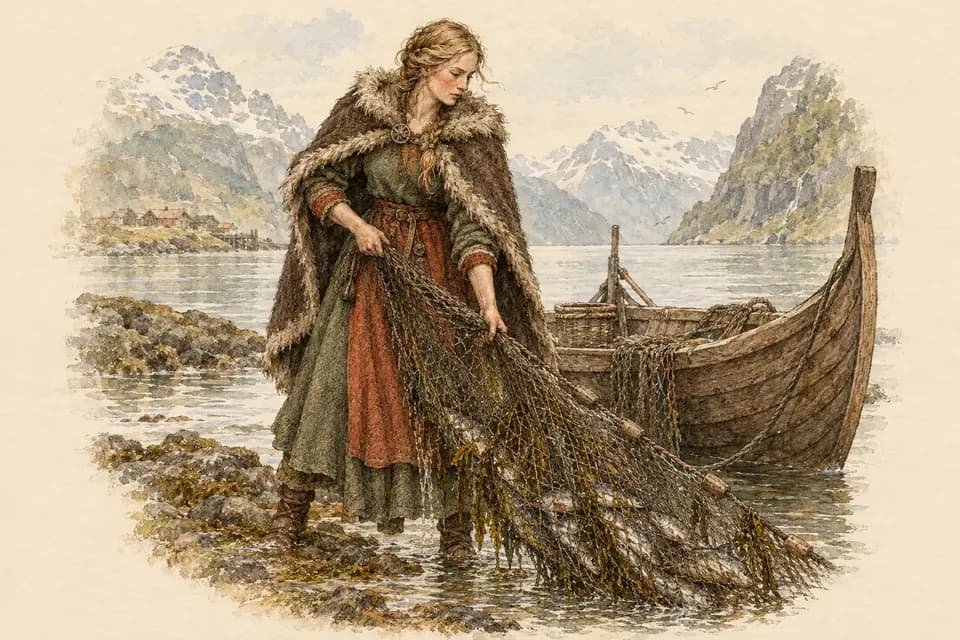
A few to start with
- BjornBear
- FreyaLady
- ErikEternal Ruler
- AstridGod + beautiful (Old Norse Ástríðr)
- LeifDescendant
- SigridVictory + beautiful (Old Norse Sigríðr)
Understanding Norse names
Viking-age names were built from a small stock of parts. Two elements joined into one name: Sigurðr (victory + guardian), Gunnhildr (war + battle), Þorsteinn (Thor + stone). Many invoked the gods, Thor above all, who appears in Þórir, Þórdís and Þorgeirr. Others were single animal words given whole: Björn (bear), Úlfr (wolf), Ormr (serpent). Families reused elements, so siblings and cousins often shared a Þór- or an -ulfr.
There were no family surnames. A man was his father's son, Leifr Eiríksson, and a woman her father's daughter, Freydís Eiríksdóttir, so the name changed every generation, as it still does in Iceland. To tell two Haralds apart, people added a byname: Harald Fairhair, Eirik Bloodaxe, Ivar the Boneless, Aud the Deep-Minded. Spelling sets the tone. Saga forms like Sigurðr and Þórr feel historical; modern forms like Sigurd and Thor read faster.
How to come up with a Norse name
Combine two name elements
Most Norse names join a first element to a second. Common openings: Ás- (god), Sig- (victory), Þór- (Thor), Ragn- (counsel, the gods), Gunn- (war), Hall- (rock). Men's endings: -steinn (stone), -geirr (spear), -mundr (protection), -ulfr (wolf). Women's endings: -hildr (battle), -dís (goddess), -ný (new), -fríðr (beautiful). Attested names like Ásgeirr, Sigmundr and Ragnhildr come straight out of this kit, and you can build your own, like Gunnsteinn or Sigdís.
Add a patronymic
Put the father's name in the possessive and add -son or -dóttir. Most names add -s: Þorsteinn gives Þorsteinsson, Ketill gives Ketilsson. Names ending in -i add -a: Snorri gives Snorrason, Tryggvi gives Tryggvason, as in Olaf Tryggvason, king of Norway. Some take -ar: Hákon gives Hákonarson. Now and then a child was named for the mother instead; the Danish king Sweyn Estridsson took his royal mother Estrid's name.
Give a byname
Bynames did the job surnames do now, and they were blunt. Appearance: Fairhair, Forkbeard, Bluetooth, the Red. Character: the Deep-Minded, the Quiet. Deeds: Bloodaxe, or Skull-Splitter, as the Orkney earl Thorfinn was called. Some were plain mockery, like Ketill Flatnose. For a game character, a byname is the fastest way to give a name a past. Hrafn the Unlucky tells the table more than Hrafn alone.
Choose a spelling system
Old Norse spelling uses þ (th as in thin), ð (th as in this) and a final -r on many men's names: Þórr, Sigurðr, Ragnarr. Modern Scandinavian forms drop the -r and the special letters: Thor, Sigurd, Ragnar. Icelandic keeps the letters but shifts the endings, as in Sigurður. Pick one system for the whole cast, so readers don't meet Sigurðr and Bjorn in the same scene.
Famous Vikings and what their names show
Historical and legendary Norse figures, with the patronymics and bynames that identified them.
- Harald Fairhair (Haraldr hárfagri)Saga tradition says he vowed not to cut his hair until he ruled all Norway, and was called Harald Shaggy (lúfa) until he did. Bynames could change over a life.
- Eirik the Red (Eiríkr rauði)Named for his red hair; formally Eiríkr Þorvaldsson. Exiled from Iceland, he settled Greenland around 985, and the sagas say he chose the name Greenland to attract settlers.
- Leif Erikson (Leifr Eiríksson)Leifr means heir or descendant, and Eiríksson simply means Eirik's son. He reached the land the sagas call Vinland around the year 1000.
- Freydís EiríksdóttirLeif's sister. Her name joins Frey- (the god Freyr, or lord) with -dís (goddess, female spirit), and her patronymic shows the daughter form, -dóttir.
- Egill SkallagrímssonA patronymic built on a byname. His father Grímr was known as Skalla-Grímr, Bald Grímr, so Egill is literally the son of Bald Grímr.
- Ragnar Lodbrok and Ivar the BonelessThe legendary Ragnar's byname, loðbrók, means shaggy breeches. His son Ívarr inn beinlausi, the Boneless, was a real leader of the Great Heathen Army; why he was called that is still argued.
- Aud the Deep-Minded (Auðr djúpúðga)One of the leading settlers of Iceland, around 900. Auðr means wealth, and her byname praises her judgment, proof that bynames weren't only for warriors.
- Harald Bluetooth (Haraldr blátǫnn)The Danish king's byname probably referred to a dead, dark tooth. Bluetooth wireless technology is named after him, and its logo joins his runic initials.
Popular Norse names
| Name | Meaning | Gender |
|---|---|---|
| Bjorn | Bear | Male |
| Freya | Lady | Female |
| Erik | Eternal Ruler | Male |
| Astrid | God + beautiful (Old Norse Ástríðr) | Female |
| Leif | Descendant | Male |
| Sigrid | Victory + beautiful (Old Norse Sigríðr) | Female |
| Thor | Thunder | Male |
| Ingrid | The god Ing + beautiful (Old Norse Ingiríðr) | Female |
| Ragnar | Counsel or the gods + army or warrior (Old Norse Ragnarr) | Male |
| Gunnhild | War Battle | Female |
| Haldor | Thor's Rock | Male |
| Eir | Mercy | Female |
| Ivar | Bow Warrior | Male |
| Solveig | Sun + strength (Old Norse Sólveig) | Female |
| Knut | Knot | Male |
| Ylva | She-Wolf | Female |
| Sten | Stone | Male |
| Asta | Love | Female |
| Roar | Famous Spear | Male |
| Bera | She-bear; Egill Skallagrímsson's mother was named Bera | Female |
60 more Norse names and meanings
Male Norse names
| Name | Meaning |
|---|---|
| Áki | Attested Old Norse masculine name; its meaning is uncertain. |
| Alvíss | “All-wise”; the name of a dwarf in Old Norse poetry. |
| Árni | A name associated with the eagle. |
| Ásgeirr | “God” or “deity” + “spear.” |
| Ásmundr | “God” or “deity” + “protection.” |
| Brandr | “Firebrand” or “torch.” |
| Eysteinn | Attested Old Norse name; its elements have debated interpretations. |
| Finnr | A Finn; an ethnonym used as a personal name. |
| Geirmundr | “Spear” + “protection.” |
| Gizurr | Attested in Norse sources; its meaning is uncertain. |
| Hákon | Historic Norse royal name with debated etymology. |
| Hallsteinn | A stone-themed compound; the first element is debated. |
| Hjalti | Attested Old Norse masculine name; its meaning is uncertain. |
| Hróðgeirr | “Fame” + “spear.” |
| Ingimundr | The god Ing + “protection.” |
| Ketill | “Cauldron”; a traditional Norse name element. |
| Njáll | Saga name; its ultimate origin and meaning are uncertain. |
| Oddr | “Point” or “spear point.” |
| Ormr | “Serpent” or “snake.” |
| Ragnvaldr | “Counsel” + “ruler.” |
| Sigurðr | “Victory” + “guardian.” |
| Snorri | Well-attested Norse name; its meaning is uncertain. |
| Styrkár | “Strength” + “warrior.” |
| Tóki | Attested Old Norse name; its meaning is uncertain. |
| Tryggvi | “Trustworthy” or “faithful.” |
| Úlfr | “Wolf.” |
| Vagn | “Wagon.” |
| Vésteinn | “Sacred place” + “stone.” |
| Þorsteinn | The god Thor + “stone.” |
| Vífill | Attested Old Norse name; its meaning is uncertain. |
Female Norse names
| Name | Meaning |
|---|---|
| Álfhildr | “Elf” + “battle.” |
| Ása | A feminine name associated with the Æsir, the Norse gods. |
| Ásgerðr | Attested Old Norse name; its meaning is uncertain. |
| Ástríðr | “God” or “deity” + “beautiful” or “beloved.” |
| Auðr | “Wealth” or “prosperity.” |
| Bergljót | Attested Norse feminine name; its full meaning is uncertain. |
| Brynhildr | “Armor” + “battle.” |
| Dagný | “New day.” |
| Dalla | Attested Norse feminine name; its meaning is uncertain. |
| Embla | Name of the first woman in Norse mythology; its origin is disputed. |
| Gerðr | Name of a figure in Norse myth; its meaning is uncertain. |
| Gróa | “To grow” or “to flourish.” |
| Guðrún | “God” or “divine” + “secret lore.” |
| Hallgerðr | Saga name with an uncertain interpretation. |
| Helga | “Holy” or “sacred.” |
| Hildr | “Battle.” |
| Ingibjörg | The god Ing + “help” or “protection.” |
| Jórunn | Attested Norse feminine name with debated meaning. |
| Katla | A feminine name formed from the name element meaning “cauldron.” |
| Ragnfríðr | “Counsel” + “beautiful” or “beloved.” |
| Ragnhildr | “Counsel” + “battle.” |
| Rúna | “Rune” or “secret lore.” |
| Sæunn | Attested Norse feminine name; its meaning is uncertain. |
| Signý | “Victory” + “new.” |
| Sigrún | “Victory” + “rune.” |
| Svanhildr | “Swan” + “battle.” |
| Þóra | Feminine form of a name based on the god Thor. |
| Þórdís | The god Thor + “female spirit” or “goddess.” |
| Vigdís | “Battle” + “female spirit” or “goddess.” |
| Yngvildr | The god Yngvi + “battle.” |
Norse last names
| Name | Meaning |
|---|---|
| Árnason | Son of Árni; a patronymic, not necessarily a fixed surname. |
| Árnadóttir | Daughter of Árni; a patronymic, not necessarily a fixed surname. |
| Ásgeirsson | Son of Ásgeir; a patronymic, not necessarily a fixed surname. |
| Ásgeirsdóttir | Daughter of Ásgeir; a patronymic, not necessarily a fixed surname. |
| Brandsson | Son of Brand; a patronymic, not necessarily a fixed surname. |
| Brandsdóttir | Daughter of Brand; a patronymic, not necessarily a fixed surname. |
| Eysteinsson | Son of Eysteinn; a patronymic, not necessarily a fixed surname. |
| Eysteinsdóttir | Daughter of Eysteinn; a patronymic, not necessarily a fixed surname. |
| Geirmundarson | Son of Geirmundr; a patronymic, not necessarily a fixed surname. |
| Geirmundardóttir | Daughter of Geirmundr; a patronymic, not necessarily a fixed surname. |
| Hákonarson | Son of Hákon; a patronymic, not necessarily a fixed surname. |
| Hákonardóttir | Daughter of Hákon; a patronymic, not necessarily a fixed surname. |
| Ketilsson | Son of Ketill; a patronymic, not necessarily a fixed surname. |
| Ketilsdóttir | Daughter of Ketill; a patronymic, not necessarily a fixed surname. |
| Ragnvaldsson | Son of Ragnvaldr; a patronymic, not necessarily a fixed surname. |
| Ragnvaldsdóttir | Daughter of Ragnvaldr; a patronymic, not necessarily a fixed surname. |
| Snorrason | Son of Snorri; a patronymic, not necessarily a fixed surname. |
| Snorradóttir | Daughter of Snorri; a patronymic, not necessarily a fixed surname. |
| Tryggvason | Son of Tryggvi; a patronymic, not necessarily a fixed surname. |
| Tryggvadóttir | Daughter of Tryggvi; a patronymic, not necessarily a fixed surname. |
Norse names: frequently asked questions
What are good Viking names for men?
Strong men's names with clear meanings: Björn (bear), Úlfr (wolf), Ívarr (bow warrior), Sigurðr (victory guardian), Þorsteinn (Thor's stone), Geirmundr (spear protection) and Ragnarr (counsel + army). Add a patronymic, as in Björn Ásgeirsson, or a byname, as in Úlfr the Black, for a complete name. Modern spellings like Bjorn, Ulf and Ivar work well if your setting isn't strictly historical.
What are good Viking names for women?
Strong women's names: Ástríðr or Astrid (god + beautiful), Sigríðr or Sigrid (victory + beautiful), Gunnhildr (war + battle), Helga (holy), Ylva (she-wolf), Auðr (wealth) and Freydís. A daughter's patronymic ends in -dóttir, as in Helga Haraldsdóttir. Shieldmaiden characters often get -hildr names, since hildr means battle and Hildr is also the name of a valkyrie.
Did Vikings have last names?
Not inherited ones. Vikings used patronymics, Árnason or Árnadóttir, which changed every generation, plus bynames like the Red or Forkbeard. In most of Scandinavia, patronymics froze into fixed family names between the 1800s and the early 1900s, giving Swedish Andersson, Danish Jensen and Norwegian Hansen. Iceland never made the switch: the singer Björk's full name is Björk Guðmundsdóttir, daughter of Guðmundur.
How do I make a Viking nickname or title?
Turn a trait into an epithet, the way the Norse did: Harald Hardrada (harðráði, hard ruler), Sweyn Forkbeard, Ketill Flatnose, Ingjaldr the Ill-Ruler. Try appearance (Hrafn the Pale), temper (Bersi the Angry), craft (Ketill the Smith) or a deed (Grímr Wolf-Slayer). For titles, use real ranks: jarl (earl), hersir (local war leader) and konungr (king).
What's the difference between Viking, Norse and Nordic names?
Norse refers to the language and people of medieval Scandinavia. Viking originally meant a sea raider, so Viking names really means Norse names of roughly 793 to 1066. Nordic usually means modern Scandinavian names such as Lars, Mikkel and Freja, and sometimes Finnish ones. Finnish names like Aino and Väinö come from a different, non-Germanic language, so keep them out of an Old Norse cast.
Are the names in Vikings and Vinland Saga real?
Mostly. Ragnar, Lagertha, Bjorn Ironside, Ivar and Floki in the TV series Vikings come from sagas and the chronicler Saxo Grammaticus, though the show rearranges their lives. Makoto Yukimura's manga Vinland Saga also draws on history: Thorfinn is based on Thorfinn Karlsefni, Canute is King Cnut (Knútr, knot), and Askeladd takes his name from Askeladden, the ash lad of Norwegian folk tales.
Other medieval name generators
Chapter one starts tonight.
Open a blank page, write the first line, and see where it takes you. Your readers are out there.
Plans from $9.99 a month. Cancel any time. Your words are always yours.