Space & New Horizons Plot Generator
Generate space plots about crews, voyages and first meetings, where distance costs time, the ship is a small society, and the far side is rarely what anyone hoped.
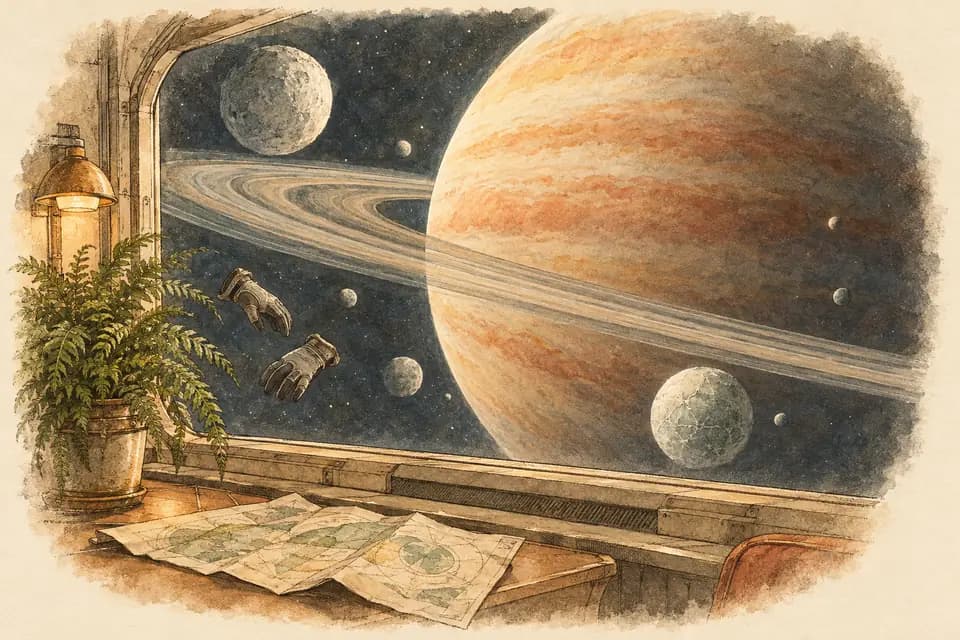
- Sample
Salvage Rights
The Aldana sisters run a salvage tug that can't afford a third crew member. When they tow in a dead mining drone and find a man frozen in its cargo hold, Pilar wants to sell him back to the company that abandoned him, and Rocío wants to wake him. He wakes on his own two days later and asks, politely, what year it is and whether Earth won.
- Sample
The Treaty Table
Femi Adeyemi is head cook on the ship carrying humanity's first delegation to the Hasch, a species that settles disputes over shared meals. He wants a quiet tour and a reference good enough to open a station kitchen of his own. Then the ambassador collapses at the welcome dinner, the Hasch declare the meal a binding vote, and Femi has eleven days to cook the human side's entire case.
- Sample
Late Arrivals
Nadia Vos is the third generation born aboard the slow ship Halcyon, raised for one task: to be first down onto the planet her grandparents chose. Ninety days out, the ship picks up a broadcast from the surface. It's a weather report, in English. Faster ships left Earth a century after hers, and the settlers below have built a museum exhibit about the Halcyon.
- Sample
A Tomorrow Repeated
A team of explorers sail through foldspace to discover uncharted planets, only to find one eerily identical to Earth, but behaving as if it's 100 years in the future. They must understand this future to save their present.
- Sample
Chasing the Last Star
In a world where stars have been extinguishing inexplicably, a lonely astrophysicist, on a starship, chases the final star, determined to fathom and halt this cosmic disaster.
- Sample
Convicts of the Cosmos
Convicts are sent to a distant planet to harvest a rare material, but soon they uncover an ancient alien wisdom that offers them a chance for redemption or ultimate destruction.
- Sample
Echoes of the Extinct
After finding a derelict spacecraft bearing signs of a superior, extinct alien civilization, humanity must grapple with the paradigm-shifting technology that promises utopia or an apocalypse.
- Sample
The Martian Chronicle
A child born on Mars yearns to journey to Earth, a planet she's only known from stories. When she stumbles upon a forgotten spaceship, her desire propels her into a forbidden adventure.
Space & New Horizons: what makes the plot work
Space & New Horizons stories focus on space exploration, cosmic mysteries, and the boundless possibilities of the universe.
Let distance shape the plot
How long a message or ship takes to arrive should change what characters can do. In Leviathan Wakes, James S. A. Corey keeps humanity inside the solar system, where travel takes days or weeks and the politics between Earth, Mars and the Belt grow from that distance. Decide your travel and communication times early, because they set the pace of every crisis.
Make the crew the story
Becky Chambers's The Long Way to a Small, Angry Planet follows a tunneling ship's crew through a long contract, and the plot is mostly the people: their species, histories and arguments. Give each crew member a private reason for being aboard. Put two of those reasons in conflict before the halfway point.
Make the alien genuinely different
In Andy Weir's Project Hail Mary, Ryland Grace meets Rocky, an engineer who speaks in musical tones and can't see light, and their friendship is built one shared word at a time. Aliens who differ in senses, scale or lifespan force your characters to work for every exchange. That work is plot.
Don't promise a kind destination
Kim Stanley Robinson's Aurora sends a generation ship to another star and then asks what happens when the new world doesn't want its settlers. Arrival can be the start of the real trouble rather than the reward. Ask what your crew will do if the place they gave their lives for turns out to be wrong.
More Science Fiction & Fantasy plot generators
Or see the whole shelf: Science Fiction & Fantasy plot ideas.
 Alternate RealitiesGenerate alternate history and parallel world plots built on one clear point of divergence, with a character who has something to lose on either side of the split.
 Magic & Fantasy FictionGenerate fantasy plots where the magic has a price, the map matters, and the trouble is more interesting than a dark lord at the end of a long road.
 Urban FantasyGenerate urban fantasy plots that put wizards, fae and things under the bridges into a real city, with a protagonist who still has rent to pay.
 High Tech FictionGenerate near-future and cyberpunk plots where the technology is one step past today, somebody is making money from it, and the person in the way has a body…
 Science FictionGenerate science fiction plots that start from one sharp question about science or society and follow it to the people who have to live with the answer.
 Role-Playing GamesGenerate plots for LitRPG and GameLit novels, or campaign hooks for your next tabletop session, where the rules of the game are part of the trouble.
 Supernatural & ParanormalGenerate ghost stories, hauntings and paranormal investigations where the dead want something specific and the living have a reason not to give it.
Names, a first scene and a title
Questions about Space & New Horizons plots
What's the difference between space opera and hard science fiction?
Space opera favors scale, adventure, politics and big casts, and it is relaxed about physics such as faster-than-light travel. Hard science fiction in space keeps to known physics, so travel times, radiation and orbital mechanics shape the plot. Many current books borrow from both, pairing realistic ships with sweeping political stakes.
Do I need faster-than-light travel?
Only if your plot needs a crowded galaxy. Without it, stories tend to stay within one solar system or become stories of very long voyages, which brings its own drama. If you include it, give it limits (cost, danger, fixed routes, side effects) so it doesn't solve every problem.
Should my space opera be a series?
Space opera readers are used to series, and publishers often hope a debut can continue. Still, write the first book so it ends on a resolved plot with room to grow. A strong standalone that could become a series is easier to sell than book one of a story that only works in five parts.
Found the plot? Write it.
Take it into Chapterly: outline it on a board, name the cast, and write chapter one tonight.
Plans from $9.99 a month. Cancel any time. Your words are always yours.