Celtic God Name Generator
Celtic names come from distinct traditions across Ireland, Wales, Scotland, and continental Europe, not one uniform naming system.
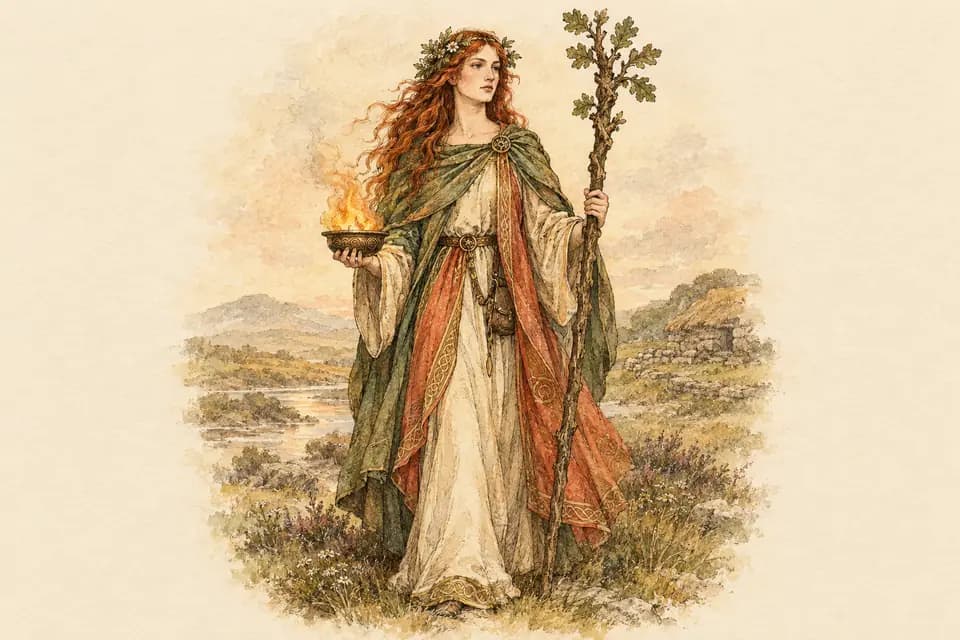
A few to start with
- CernunnosHorned God of the Forest
- BrigidGoddess of Fire and Hearth
- LughGod of Light and Arts
- MorriganGoddess of War and Fate
- DagdaFather God and Protector
- DanuMother Goddess of the Tuatha Dé Danann
Understanding Celtic God names
Celtic gods are the deities from the mythology of the Celtic peoples, particularly in Ireland, Scotland, and Wales. They are often associated with nature, magic, and various elements. Celtic mythology is rich with stories of gods and goddesses who have a deep connection with the land.
Their sounds range from compact names such as Macha to longer forms such as Math fab Mathonwy, with accents and consonant combinations that reflect different languages and spelling histories. Many are known through medieval Irish and Welsh stories or inscriptions left by ancient communities. For fiction, a name can signal a character’s cultural setting, divine role, or connection to land and water. Check the tradition behind a name before pairing it with a particular setting.
How to come up with the perfect Celtic God name
Celtic god names often reflect their characteristics, domains, and their association with nature. Names like Cernunnos, Brigid, and Morrigan are common among Celtic gods.
Notice the language and spelling
Celtic traditions include several languages, each with its own sounds and spelling conventions. Irish names such as Áine and Welsh names such as Gwydion do not follow one shared pronunciation system. Accents in Irish spellings, as in Ériu, are meaningful parts of the written form. For a historically grounded character, keep the spelling tied to the tradition you are drawing from rather than combining forms simply because they look similar.
Look beyond a name’s sound
Many names survive because they belong to a particular story, place, or divine role. Boann is associated with the River Boyne, while Sequana is linked to the Seine. Others, such as Taranis or Dian Cécht, are known chiefly through their divine associations. A name’s story can be a more reliable guide to its use than a neat modern translation; not every ancient name has a certain, agreed meaning.
Choose for your story’s setting
Decide whether your character belongs to an Irish, Welsh, or continental Gaulish-inspired world, then use names from that tradition consistently. Consider the role as well as the sound: a healer might suit a name associated with healing, while a river spirit could draw on a water-linked figure. If you adapt a name for fantasy, make clear in your notes which details come from lore and which are your invention.
Popular Celtic God names
Embark on a journey through Celtic god names inspired by the enchanting mythology of the Celts:
| Name | Meaning | Gender |
|---|---|---|
| Cernunnos | Horned God of the Forest | Male |
| Brigid | Goddess of Fire and Hearth | Female |
| Lugh | God of Light and Arts | Male |
| Morrigan | Goddess of War and Fate | Female |
| Dagda | Father God and Protector | Male |
| Danu | Mother Goddess of the Tuatha Dé Danann | Female |
| Nuada | God of the Tuatha Dé Danann | Male |
| Rhiannon | Goddess of Horses and Birds | Female |
| Arawn | Lord of Annwn (the Otherworld) | Male |
| Epona | Goddess of Horses and Fertility | Female |
| Lir | God of the Sea | Male |
| Blodeuwedd | Flower Face, Goddess of Spring | Female |
| Ogma | God of Eloquence and Learning | Male |
| Cailleach | Goddess of Winter and Storms | Female |
| Manannan | God of the Sea and Guardianship | Male |
| Arianrhod | Silver Wheel, Goddess of the Moon | Female |
| Crom Cruach | Ancient God of Sacrifice | Male |
| Rigantona | Great Queen | Female |
| Sucellus | God of Agriculture and Forests | Male |
| Nantosuelta | Goddess of Nature and Healing | Female |
| Cathubodua | Battle Crow, War Goddess | Female |
59 more Celtic God names and meanings
Male Celtic God names
| Name | Meaning |
|---|---|
| Aengus | Irish god associated with youth, love, and poetic inspiration. |
| Dian Cécht | Irish healer god of the Tuatha Dé Danann. |
| Miach | Healer of the Tuatha Dé Danann; son of Dian Cécht. |
| Goibniu | Irish smith god of the Tuatha Dé Danann. |
| Credne | Irish craftsman god who worked with bronze. |
| Luchta | Irish craftsman god associated with woodworking. |
| Bres | King of the Tuatha Dé Danann in Irish myth. |
| Balar | Fomorian figure known for his destructive eye. |
| Elatha | Fomorian prince and father of Bres. |
| Neit | Irish war god. |
| Midir | Irish Otherworld figure of the Tuatha Dé Danann. |
| Mac Gréine | One of three Tuatha Dé Danann kings. |
| Mac Cuill | One of three Tuatha Dé Danann kings. |
| Mac Cécht | One of three Tuatha Dé Danann kings. |
| Gwydion | Welsh magician and hero of the Mabinogi. |
| Math fab Mathonwy | Welsh ruler and magician in the Fourth Branch. |
| Amaethon | Welsh figure associated with agriculture. |
| Gofannon | Welsh smith figure, counterpart to Goibniu. |
| Lludd | Welsh king whose story features in medieval legend. |
| Beli Mawr | Welsh ancestral figure in medieval genealogies. |
| Gwynn ap Nudd | Welsh Otherworld ruler associated with Annwn. |
| Dylan ail Don | Welsh sea figure, son of Don. |
| Taranis | Gaulish thunder god known from inscriptions. |
| Toutatis | Gaulish divine title often understood as protector of a people. |
| Esus | Gaulish god known from inscriptions and Roman-era reliefs. |
| Belenos | Gaulish god associated with healing and light. |
| Borvo | Gaulish healing god associated with hot springs. |
| Grannus | Gaulish healing god linked with thermal springs. |
| Maponos | Gaulish god associated with youth. |
| Ogmios | Gaulish god associated with eloquence and persuasive speech. |
| Camulus | Gaulish war god known from inscriptions. |
| Lenus | Healing god worshipped in the region of the Treveri. |
Female Celtic God names
| Name | Meaning |
|---|---|
| Áine | Irish goddess associated with summer and sovereignty. |
| Macha | Irish goddess linked with sovereignty and battle. |
| Ériu | Goddess whose name is associated with Ireland. |
| Banba | One of three goddesses associated with Ireland. |
| Fódla | One of three goddesses associated with Ireland. |
| Boann | Goddess associated with the River Boyne. |
| Sinann | Goddess associated with the River Shannon. |
| Tailtiu | Figure honored in the Irish festival of Lughnasadh. |
| Badb | Irish war goddess associated with battle and prophecy. |
| Nemain | Irish war goddess associated with battle’s terror. |
| Fea | Irish war goddess named among the Morrígna. |
| Bé Chuille | Tuatha Dé Danann figure associated with magic. |
| Airmed | Healing figure associated with medicinal herbs. |
| Flidais | Irish goddess associated with wild animals and abundance. |
| Étaín | Irish Otherworld woman central to a tale of transformation. |
| Fand | Otherworld woman in the Ulster Cycle. |
| Don | Welsh mother figure associated with a divine family. |
| Modron | Welsh mother figure linked with the hero Mabon. |
| Ceridwen | Welsh enchantress associated with a cauldron of inspiration. |
| Creiddylad | Welsh maiden whose story is tied to seasonal conflict. |
| Branwen | Welsh heroine of the Second Branch of the Mabinogi. |
| Olwen | Welsh heroine in the tale of Culhwch and Olwen. |
| Belisama | Gaulish goddess known from inscriptions. |
| Rosmerta | Gaulish goddess often shown with Mercury. |
| Sirona | Gaulish goddess associated with healing springs. |
| Andraste | British goddess invoked by the Iceni queen Boudica. |
| Sequana | Goddess associated with the River Seine. |
Celtic God last names
| Name | Meaning |
|---|---|
| Ó Briain | Irish: descendant of Brian. |
| Ó Néill | Irish: descendant of Niall. |
| Ó Conchobhair | Irish: descendant of Conchobhar. |
| Ó hÓgáin | Irish: descendant of Ógán. |
| Ó Floinn | Irish: descendant of Flann. |
| Ó Cearbhaill | Irish: descendant of Cearbhall. |
| Mac Cárthaigh | Irish: son of Cárthach. |
| Mac Aodha | Irish: son of Aodh. |
| Mac Giolla Bhríghde | Irish: son of a devotee of Brigid. |
| Ó Dubháin | Irish: descendant of Dubhán. |
| Mac Coinnich | Scottish Gaelic: son of Coinneach. |
| MacLeòid | Scottish Gaelic: son of Leòd. |
| Mac an t-Saoir | Scottish Gaelic: son of the carpenter. |
| MacDhòmhnaill | Scottish Gaelic: son of Domhnall. |
| ap Rhys | Welsh patronymic: son of Rhys. |
| ap Hywel | Welsh patronymic: son of Hywel. |
| ap Gwilym | Welsh patronymic: son of Gwilym. |
| Evans | Welsh surname: descendant of Evan, the Welsh form of John. |
| Griffiths | Welsh surname: descendant of Gruffudd. |
| Vaughan | Welsh surname from bychan, meaning small or younger. |
Celtic God names: frequently asked questions
What are common Celtic names?
There is no single set of names shared by every Celtic-speaking culture. Irish myth includes Aengus, Macha, and Boann; Welsh tradition includes Gwydion and Ceridwen; ancient Gaulish inscriptions preserve names such as Taranis and Rosmerta. Choose examples from the region and period that fit your character’s background.
What does the name Taranis mean?
Taranis is the name of a Gaulish thunder god known from ancient inscriptions. It is commonly connected with a Celtic word for thunder, so “thunder god” is a useful description of the figure, rather than a certain literal translation of the name. The spelling Taranis is well established in modern references.
Are Celtic names Irish, Welsh, and Scottish names?
They can be, but “Celtic” covers a wider range of cultures and languages. Irish and Scottish Gaelic share some linguistic history, while Welsh belongs to the Brittonic branch; ancient Gaulish was spoken on the European mainland. Names such as Áine, Gwydion, and Sequana belong to different traditions, not one interchangeable naming pool.
How can I choose a Celtic-inspired name for a character?
Start with the character’s cultural setting and role, then look for a name from a matching tradition. A river-linked figure such as Boann may suit a water spirit, while the Welsh magician Gwydion could inspire a cunning spellcaster. Preserve the original spelling when possible, and distinguish your own fantasy adaptations from historical lore.
Other gods name generators
Chapter one starts tonight.
Open a blank page, write the first line, and see where it takes you. Your readers are out there.
Plans from $9.99 a month. Cancel any time. Your words are always yours.