Egyptian God Name Generator
Ancient Egyptian divine names come from a long, multilingual history: their forms reach us through hieroglyphic writing, later Egyptian scripts, and Greek or Latin transcription.
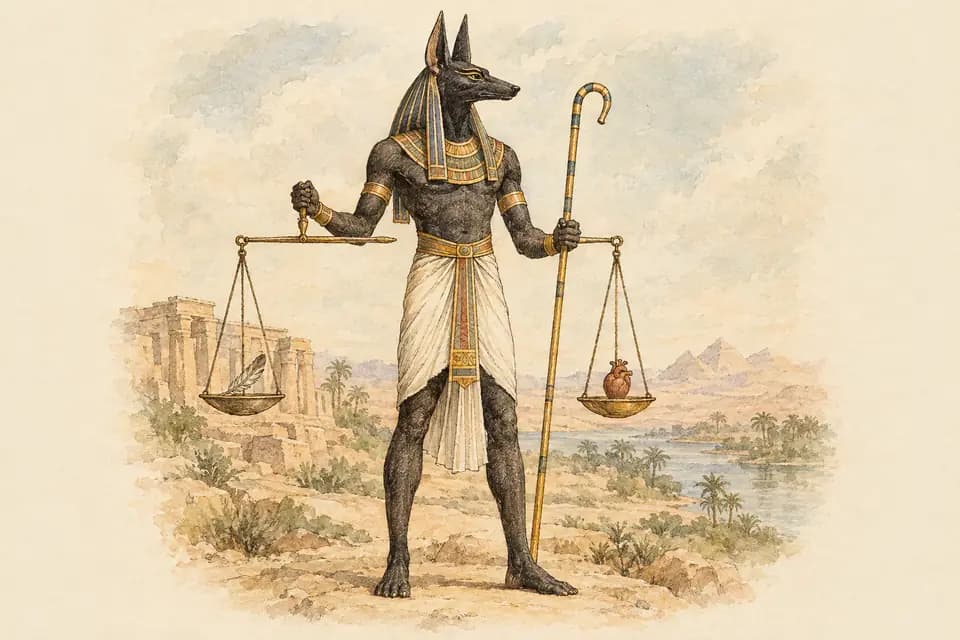
A few to start with
- RaSun God
- IsisGoddess of Magic
- AnubisGod of the Dead
- HathorGoddess of Love and Music
- ThothGod of Wisdom
- BastetGoddess of Cats
Understanding Egyptian God names
Egyptian gods are the deities from ancient Egyptian mythology, deeply rooted in the civilization's religious and cultural beliefs. They embody various natural elements, concepts, and aspects of life. From Ra, the sun god, to Isis, the goddess of magic, each Egyptian god has a unique role in the pantheon.
As a result, one deity may appear under several spellings, such as Amun and Amon. Many names belong to gods tied to a place, natural force, royal power, or ritual duty, and some deities share roles or combine over time. For fiction, these names can signal a character’s domain or cultural setting. Choose a spelling that suits your world, and use a deity’s well-attested role as inspiration rather than treating every name as a simple label.
How to come up with the perfect Egyptian God name
Egyptian god names often reflect their attributes and domains. Names like Ra, Isis, and Anubis are common among Egyptian gods.
How divine names are formed
Egyptian names were written with consonantal signs, and modern spellings often supply vowels for readability. This is why familiar forms can differ across books: Amun may also appear as Amon, while Greek-influenced spellings can differ from Egyptological ones. Pick one transliteration style and use it consistently. A deity’s name may also have a longer ceremonial form or appear alongside a title.
Roles, places, and shared identities
Many deities are associated with specific functions: Seshat with writing and measurement, Taweret with childbirth and protection, and Wepwawet with opening the way. A god’s importance could vary by city and era, and divine identities sometimes merged or overlapped. For a story, a name can suggest a domain, but avoid assuming every deity had one fixed role throughout Egyptian history.
Choosing a name for your story
Start with the character’s role, then look for a deity whose traditional associations fit or deliberately contrast with it. Check the spelling and gender presentation you want, especially when using variants or lesser-known gods. Ancient Egyptians did not generally use hereditary surnames in the modern sense, so titles, parentage, place of origin, or an epithet can feel more fitting than a modern-style family name.
Popular Egyptian God names
Discover a world of Egyptian god names inspired by the ancient mythology of Egypt:
| Name | Meaning | Gender |
|---|---|---|
| Ra | Sun God | Male |
| Isis | Goddess of Magic | Female |
| Anubis | God of the Dead | Male |
| Hathor | Goddess of Love and Music | Female |
| Thoth | God of Wisdom | Male |
| Bastet | Goddess of Cats | Female |
| Horus | Sky God | Male |
| Sekhmet | Goddess of War | Female |
| Osiris | God of the Afterlife | Male |
| Ma'at | Goddess of Truth and Justice | Female |
| Set | God of Chaos | Male |
| Nephthys | Goddess of Mourning | Female |
| Ptah | Creator God | Male |
| Neith | Goddess of War and Weaving | Female |
| Khonsu | God of the Moon | Male |
| Nut | Goddess of the Sky | Female |
| Anuket | Goddess of the Nile | Female |
| Khnum | God of Creation | Male |
| Sobek | God of Crocodiles | Male |
| Tefnut | Goddess of Moisture | Female |
60 more Egyptian God names and meanings
Male Egyptian God names
| Name | Meaning |
|---|---|
| Amun | Creator god associated with Thebes; later joined with Ra. |
| Atum | Creator deity associated with Heliopolis and the setting sun. |
| Apep | Chaos serpent who opposes the sun god’s journey. |
| Apis | Sacred bull deity worshipped at Memphis. |
| Bes | Protective household deity linked with music and childbirth. |
| Hapy | God of the Nile’s life-giving inundation. |
| Heka | God embodying the power of magic. |
| Heh | Personification of boundless time and infinity. |
| Hu | Personification of authoritative speech. |
| Sia | Personification of perception and understanding. |
| Wepwawet | Jackal deity known as the opener of the ways. |
| Imsety | Human-headed guardian of the deceased’s liver. |
| Duamutef | Jackal-headed guardian of the deceased’s stomach. |
| Hapi | Baboon-headed guardian of the deceased’s lungs. |
| Qebehsenuef | Falcon-headed guardian of the deceased’s intestines. |
| Heryshaf | Ram god worshipped at Herakleopolis Magna. |
| Kherty | Ram-headed underworld deity associated with the dead. |
| Nefertem | God of the lotus and the dawn. |
| Onuris | Warrior god whose name is also rendered Anhur. |
| Montu | Falcon-associated god of war and Thebes. |
| Min | God of fertility and male generative power. |
| Geb | Earth god and father of Osiris, Isis, Set, and Nephthys. |
| Shu | God of air who separates earth and sky. |
| Khepri | Dawn deity represented by a scarab beetle. |
| Aker | Earth and horizon deity guarding the sun’s passage. |
| Andjety | Ancient god associated with the city of Andjet. |
| Ash | God associated with the western desert and its oases. |
| Dedun | God associated with incense and Nubia. |
| Ihy | Child god associated with music and the sistrum. |
| Maahes | Lion-headed god associated with protection and warfare. |
Female Egyptian God names
| Name | Meaning |
|---|---|
| Amunet | Goddess paired with Amun in ancient creation traditions. |
| Seshat | Goddess of writing, recordkeeping, and measurement. |
| Renenutet | Goddess associated with nourishment, harvest, and fortune. |
| Serqet | Scorpion goddess who protects against venom. |
| Taweret | Hippopotamus goddess who protects childbirth and the household. |
| Meskhenet | Goddess associated with childbirth and a person’s fate. |
| Meretseger | Goddess who guarded the Theban necropolis. |
| Pakhet | Lioness goddess associated with fierce protection. |
| Menhit | Lioness goddess associated with war and protection. |
| Wosret | Theban goddess whose name means “the Powerful One.” |
| Anat | Warrior goddess of West Asian origin worshipped in Egypt. |
| Astarte | Goddess of war and fertility adopted from West Asia. |
| Qetesh | Goddess of love and sexuality with West Asian roots. |
| Mut | Theban mother goddess and consort of Amun. |
| Iusaaset | Primordial goddess associated with creation and the acacia tree. |
| Nebethetepet | Goddess linked with Atum and the act of creation. |
| Werethekau | Goddess whose name means “Great of Magic.” |
| Heqet | Frog goddess associated with fertility and childbirth. |
| Naunet | Goddess of the primeval waters in the Ogdoad. |
| Kauket | Goddess of darkness in the Hermopolitan Ogdoad. |
| Sopdet | Goddess associated with the star Sirius and the Nile year. |
| Satis | Goddess of the Nile cataracts and inundation. |
| Keket | Goddess of darkness in the Hermopolitan Ogdoad. |
| Wadjet | Cobra goddess and protector of Lower Egypt. |
| Nekhbet | Vulture goddess and protector of Upper Egypt. |
| Mafdet | Goddess who protected against dangerous animals and venom. |
| Bat | Ancient cow goddess associated with the sky and kingship. |
| Imentet | Goddess who personified the western land of the dead. |
| Reret | Protective goddess represented as a hippopotamus. |
| Anput | Goddess associated with funerary rites and the seventeenth nome. |
Egyptian God last names
| Name | Meaning |
|---|---|
| The Hidden One | A title evoking the hidden nature associated with Amun. |
| Lord of the Two Lands | Royal-style title for a ruler of Upper and Lower Egypt. |
| Lady of the Two Lands | Feminine royal-style title for a ruler of both regions. |
| Lord of the Horizon | Epithet suggesting command of the sun’s threshold and sky. |
| Mistress of the West | Title evoking the western realm of the dead. |
| Opener of the Ways | Epithet for a guide who clears paths for the living or dead. |
| Guardian of the Necropolis | Title for a protector of tombs and burial grounds. |
| Keeper of the Scales | Story-ready title invoking judgment in the afterlife. |
| Beloved of the Gods | Honorific suggesting divine favor. |
| Chosen of Amun | Royal-style honorific linking a character to Amun’s favor. |
| Servant of the Temple | Role-based designation for a temple attendant. |
| Scribe of the House of Life | Title for a learned temple scribe. |
| Singer of the Sacred Barque | Ceremonial role for a performer in a god’s procession. |
| Keeper of the Sacred Lake | Temple-duty title suited to a ritual guardian. |
| Heir of the Nile | Poetic title suggesting a bond to Egypt’s river. |
| Falcon of the South | Honorific evoking falcon imagery and Upper Egypt. |
| Bull of the Desert | Fierce epithet suggesting strength in harsh country. |
| The Gold-Handed | Poetic epithet for a craftsperson or giver of precious gifts. |
| Son of the Great House | Descriptive designation connecting someone to the royal household. |
| Daughter of the Great House | Descriptive designation connecting someone to the royal household. |
Egyptian God names: frequently asked questions
What are common Egyptian god names?
Well-known names include Amun, Osiris, Isis, and Horus, though those familiar figures are only part of a much larger pantheon. Less familiar options include Seshat, the goddess of writing and measurement; Wepwawet, the opener of the ways; and Taweret, a household protector associated with childbirth.
What does Amun mean?
Amun’s name is commonly interpreted as “the Hidden One.” He was especially important at Thebes and, in later periods, was often combined with the sun god Ra as Amun-Ra. Spellings vary in modern sources, including Amun and Amon, because Egyptian names were transmitted through different writing and transcription systems.
How were ancient Egyptian names written?
Egyptian writing represented consonants with hieroglyphic signs, while many modern spellings add vowels to make names pronounceable. That is why a name may have variant forms, such as Onuris and Anhur. For a story, choose one familiar spelling system and keep it consistent rather than mixing versions at random.
Did ancient Egyptians have surnames?
Hereditary family surnames in the modern sense were not generally used in ancient Egypt. People could be identified by a personal name, parentage, occupation, title, or place of origin. For fiction, a designation such as “Scribe of the House of Life” or “Daughter of the Great House” will usually feel more apt than a modern-style surname.
Other gods name generators

Chapter one starts tonight.
Open a blank page, write the first line, and see where it takes you. Your readers are out there.
Plans from $9.99 a month. Cancel any time. Your words are always yours.